The short version
Loading home page
A successful pilot proves that an AI capability can work in a controlled setting. Enterprise scale depends on whether the organization around it can make that performance repeatable.
Curated by

Dr. Stéphane Niango
Research LeadershipExpert in DCOs & Strategic Transformation
DigitalQatalyst
Dr Stéphane Niango is a globally recognised digital transformation architect, strategy consultant and organisational design expert specialising in the evolution of Digital Cognitive Organizations (DCOs).
A pilot proves the capability. Scale tests the enterprise. The missing layer is enterprise readiness across organization, governance, work, platform and execution.
AI pilots are designed to reduce uncertainty. They often use selected data, a narrow workflow, a limited user group and direct support from the people who built the solution. That is good experiment design, but it can also hide the dependencies that make wider deployment difficult.
For CIOs, CDOs and CAIOs, the scale decision therefore starts after technical feasibility has been established. The question is whether the enterprise can operate the capability repeatedly across normal conditions without relying on exceptional access, local knowledge, temporary approvals or intensive support.
The scaling gap is the distance between a capability that works in a pilot and a capability the enterprise can operate repeatedly. It appears when a use case still depends on conditions that were created specifically for the experiment: a sponsor who clears decisions quickly, specialists who repair data manually, a workflow that bypasses normal processes, an isolated technology setup, or a delivery team that stays unusually close to every user.
A pilot can hide work that the enterprise will eventually have to absorb. When the pilot team steps back, manual data fixes, informal approvals, direct user support and one-off integrations have to become normal operating capability. If they do not, technical performance may remain strong while delivery becomes slow, inconsistent, costly or difficult to govern.
External research supports the broader point that AI value depends on more than model performance. McKinsey's State of AI in early 2024 documents rapid AI adoption alongside growing efforts to generate business value. Its research on digital transformation success also examines the organizational conditions associated with large-scale change. For a scale decision, the implication is straightforward: test the enterprise conditions around the AI with the same discipline used to test the capability itself.
DigitalQatalyst's Enterprise AI Value Gap framework places this problem inside enterprise readiness. For the C3 scaling question, five conditions matter most: organization, governance, work, platform and execution. Treat them as one operating layer rather than five separate programmes. Together, they determine whether pilot success can survive contact with the wider enterprise.
This is also why pilot metrics cannot simply be carried forward into scale decisions. Model performance, user response and a bounded business outcome can show that the use case works. Scale requires additional evidence that ownership, workflow, data access, controls, support and improvement mechanisms can hold when the capability moves beyond the original setting.
Organization. Scale needs accountable ownership and coordination that extend beyond the pilot team. If a use case still depends on one sponsor, one specialist group or informal access to decision-makers, the organization has not yet absorbed the capability.
Governance. Wider use increases the number of decisions, users and consequences around the AI. Decision rights, controls, escalation and review therefore need to remain clear as the capability moves into normal operations.
Work. A pilot can succeed while people manually bridge broken process steps. At scale, those workarounds become bottlenecks. The workflow has to be redesigned so the capability fits how work is actually assigned, reviewed, handed over and completed.
Platform. Repeatable scale requires data access, integration and shared technology foundations that can be reused. If every deployment rebuilds the same connections, permissions or workflow links, the enterprise is expanding one use case at a time rather than creating repeatable scale.
Execution. The enterprise needs a repeatable way to deploy, monitor, support and improve the capability after the pilot team steps away. In 6xD, Digital Transformation 2.0 provides this execution lens: transformation becomes an enterprise capability when delivery can be repeated under normal operating conditions rather than recreated as a special project each time.
Enterprise readiness connects a successful AI pilot to repeatable enterprise scale through organization, governance, work, platform and execution.Figure 1. The missing layer between technical feasibility and repeatable enterprise scale.
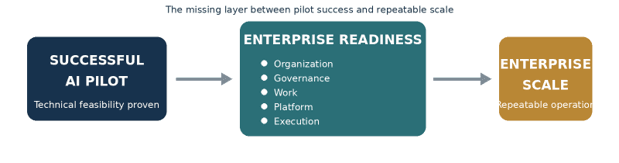
Read the five conditions as one connected readiness layer, not as independent scores. A strong platform cannot compensate for unclear decision rights. Clear governance cannot compensate for a workflow that still depends on manual intervention. Redesigned work cannot scale if each deployment has to rebuild data access and integration from scratch.
The first condition that fails under wider use is the constraint. That is the key C3 distinction. The scale question asks whether the enterprise has removed the dependencies that made success possible only inside pilot conditions.
At your next scale review, separate the evidence into two groups. First, record what the pilot has proved about the AI capability: technical performance, user response and the bounded outcome. Then record what the enterprise still has to prove: accountable ownership, a repeatable workflow, reusable data and integration, a clear governance path, ongoing support, monitoring and improvement.
Then ask one question: what would fail first if this pilot had to operate at enterprise volume tomorrow? If the answer is still inside the model or use case, improve the capability. If the answer is an approval path, workflow, integration, operating role or support dependency, fix that enterprise condition before multiplying deployments.
Use these questions in the next pilot-to-scale decision:
If one of these questions cannot be answered without the pilot team in the room, you have probably found the next scaling constraint.
A software release can turn an AI agent's recommendation into a transaction. Before granting consequential permissions, record who approved the action, what limits apply and who can intervene.
Successful AI pilots prove bounded feasibility, not enterprise value. Value depends on whether the enterprise can connect AI to measurable outcomes through Strategy, Organization, Governance, Work, Platform and Execution.
A software release can turn an AI agent's recommendation into a transaction. Before granting consequential permissions, record who approved the action, what limits apply and who can intervene.
An AI risk report can show every control as green while leaving investment authority and business value ownership unclear. Boards need one accountable record linking purpose, permissions, funding and observed results.