The short version
Loading home page
How boards can connect responsible AI use to authorized decisions, accountable investment and evidence of enterprise value.
Curated by

Mark Kerry
Research LeadershipDigital Transformation & Enterprise Architecture
DigitalQatalyst
Mark Kerry is a Digital Transformation and Enterprise Architecture leader at DigitalQatalyst, enabling change through the practical application of enterprise architecture, agile and associated best practices.
Passing AI risk controls does not establish business value. Directors need evidence linking the authorized decision, investment sponsor, outcome owner and results before expansion.
Your AI risk report is green. Who can defend the next decision?
An audit and risk committee may see privacy and security reviews completed, controls assigned and monitoring in place. Yet the same report may omit who authorized the AI use, which business executive owns its promised result and what evidence would justify expansion. These questions remain even when risk controls work as designed.
AI risk management checks whether uses stay within approved limits. Passing controls show progress on safeguards, but do not establish why the investment matters, who owns the business result or what warrants further funding.
The NIST AI Risk Management Framework connects governance roles, policies and risk decisions to organizational priorities across the AI lifecycle (NIST, 2023). The OECD AI Principles emphasize accountability and traceability (OECD, updated 2024). Both support responsible use; enterprise leaders must still decide who sponsors investment and owns business outcomes.
From the 6xD Digital Cognitive Organization (D2) perspective, the board should trace a material AI use from enterprise purpose and delegated authority through investment sponsorship to a measured business outcome. Risk and assurance functions challenge that chain. They do not replace executives accountable for investment decisions or operating results.
Risk reduction can be a legitimate business benefit. Management should identify the exposure, baseline, accountable owner and cost of controls and deployment. Continuity, safety and avoided harm need not appear as immediate cash returns. For nonfinancial benefits, the evidence and review date should still be explicit.
For material AI uses, boards should examine purpose, authorized decisions, accountable investment and evidence of business outcomes together. Risk oversight informs that judgement but cannot substitute for accountable executive ownership.
Start with one material AI use. The AI Accountability Gap research connects three accountabilities: an authorized decision-maker, investment sponsor and business outcome owner. One evidence record links their responsibilities. The five checks below apply this framework to board review; they are not new roles or a competing model.
Figure 1. Five board-review checks applying the three accountabilities.
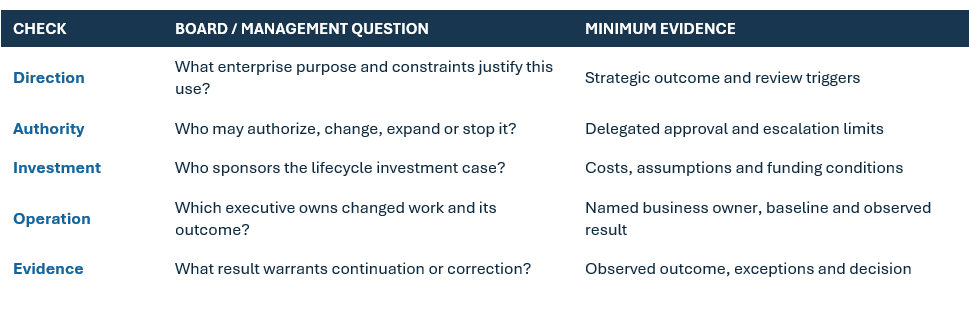
Use the checks as one enquiry, not separate approval queues. A passing risk assessment cannot compensate for an absent outcome owner. Mark answers evidenced, partial or missing. For material gaps, assign a corrective owner, deadline and effect on the next decision. These labels are qualitative guidance, not a validated score.
Link the record to existing budgets, risk assessments, delegations and performance evidence. Name the owner and decision date without creating another reporting layer. Its purpose is a traceable next decision.
The board or designated committee sets oversight expectations, challenges material investment and risk decisions, and reviews major exceptions. Management turns that mandate into delegations, funding proposals, operating controls, performance reporting and corrective action. Actual powers must follow applicable law, the organization's governing documents and approved delegations.
The CFO tests lifecycle costs and benefit assumptions. A business executive owns changes to the work and reports results. Technology leaders own delivery and reliability. Risk, legal and compliance provide challenge; internal audit gives independent assurance under its mandate. Calling everyone the 'AI owner' obscures accountability. Several roles may sit with one executive, but each responsibility should remain explicit.
Changes to AI authority, funding, risk exposure or expected benefits may require escalation. Management must know who can restrict, redesign or stop the use before permissions or investment expand.
An expected benefit cannot excuse an unmet mandatory control. Authorized decisions must stay within approved risk appetite, applicable requirements and delegations. Record material dissent, conditions and review dates so oversight can verify that management acted within its authority.
Consider a hypothetical retailer using AI-assisted demand forecasting. Security, vendor and data controls are approved, and a central technology budget supports deployment. The enterprise expects fewer stockouts without higher inventory costs, yet no executive responsible for replenishment has accepted ownership of the result.
The supply-chain executive should accept a target, baseline and review date; the sponsor should defend continuing costs. Management should compare stock availability and inventory costs, allowing for promotions, supplier changes and seasonality. Better stock availability does not automatically prove AI caused it.
This example is hypothetical. It shows why risk approval and evidence of realized value require separate tests and owners.
At the next committee meeting, select one material AI use and request a dated record of its objective, delegated approval, investment sponsor, outcome owner, baseline, observed result, exceptions and next decision. Keep forecasts separate from achieved results; assign owners and deadlines for material gaps.
The board need not operate AI or approve routine changes. It should ask whether material decisions were authorized, whether management owns their consequences and whether weak evidence changes plans to continue, expand, correct or stop.
Board test: If every AI control were marked green tomorrow, who would own the promised result, and what evidence would justify expansion?
Before expanding funding or authority, ask management what evidence supports proceeding and what finding would reverse its recommendation. Partial evidence needs a corrective owner, test and date. Missing authority or a mandatory control must follow approved escalation routes. Within approved limits, the authorized approver may continue a trial, change conditions or defer expansion.
An AI pilot can pass its risk checks without proving a business case or naming an outcome owner. Scaling needs a separate, authorized decision about value, funding and accountability.
Successful AI pilots prove bounded feasibility, not enterprise value. Value depends on whether the enterprise can connect AI to measurable outcomes through Strategy, Organization, Governance, Work, Platform and Execution.
An AI pilot can pass its risk checks without proving a business case or naming an outcome owner. Scaling needs a separate, authorized decision about value, funding and accountability.
Pilots, licenses, use cases and deployments are inputs; the executive issue is whether those inputs produce measurable enterprise outcomes.