Loading home page
An enterprise operating model for decision rights, AI investment and measurable business results
Curated by

Dr. Stéphane Niango
Research LeadershipExpert in DCOs & Strategic Transformation
DigitalQatalyst
Dr Stéphane Niango is a globally recognised digital transformation architect, strategy consultant and organisational design expert specialising in the evolution of Digital Cognitive Organizations (DCOs).
Every material AI initiative needs a decision authority, investment sponsor and business outcome owner, tied to one evidence record.
An enterprise operating model for decision rights, AI investment and measurable business results
A board can approve a major AI investment and still discover, a year later, that no executive is prepared to account for the promised business result. Technology may have been delivered. Budgets may have been spent. Policies may have been followed. Yet the result belongs to no one in particular.
This is the AI accountability gap. It can arise when one function authorizes a capability, another funds it and a third is expected to manage its consequences. The split becomes harder to examine when AI capabilities cross technology, finance, risk and business operations or take part in decisions and transactions.
The immediate board question is therefore practical: Can management produce one reliable record of who decides, who pays and who owns the outcome? If it cannot, the enterprise has an accountability problem before it has a scaling problem.
This whitepaper explains how to expose that gap, assign the three accountabilities and connect them to evidence that informs a decision to continue, change or stop an AI investment.
Enterprise AI can reshape business decisions, operating processes, capital allocation and risk exposure. Where reporting is split across technology, investment and compliance channels, directors may see a growing AI portfolio without a clear account of who authorized each material use, who sponsors its economic case and who owns the business result. In a 2026 survey conducted by HFS Research with EY, only 17% of 302 Global 2000 executives reported clear, consistently applied accountability when AI-influenced decisions led to negative outcomes; 38% said accountability was settled case by case (HFS Research, 2026). This indicates a related ownership weakness in that sample, not the prevalence of the complete decision-funding-outcome gap.
Other survey findings show the scale of AI adoption and organizational change, but measure different issues. Stanford's 2026 AI Index, drawing on McKinsey survey data, reports that 88% of surveyed organizations used AI in at least one business function in 2025 (Stanford HAI, 2026). A separate McKinsey report published in March 2025 found that 21% of respondents reporting organizational generative AI use said at least some workflows had been fundamentally redesigned (McKinsey & Company, 2025). These reports describe adoption and operating change, not audited investment returns or the full assignment of decision, funding and outcome responsibility.
The 6xD proposition is straightforward: each material AI initiative needs a recorded decision authority, an accountable investment sponsor and a named business outcome owner, tied to one evidence trail. The roles are distinct accountabilities, not necessarily three different people. Appropriate separation of duties and independent challenge remain essential. Each record should specify approval and escalation limits, full-life cost, baseline and target outcomes, risk conditions, review dates and stop rights.
The 6xD Enterprise AI Governance System provides the parent architecture: five governing functions, eight responsibility domains and a board-management boundary (Niango, 2026a). RP01 applies it to one executive decision problem, making authority, investment sponsorship and outcome ownership visible together. Directors set oversight conditions; management delivers and reports against them.
The operating model also addresses agentic systems, where permission to act may extend beyond recommendation into transaction, communication or execution. More autonomy requires clearer authority limits and monitoring, but does not transfer organizational accountability to software.
A board can begin with its highest-exposure AI uses, identify missing owners and challenge promised benefits before approving expansion. The paper provides a 90-day agenda, a reporting blueprint and a practical board test. The 6xD model is an analytical proposal, not a validated maturity instrument or a guarantee of investment returns.

A conventional technology project typically has a delivery sponsor, budget, technical team and acceptance criteria. An AI deployment may require a broader arrangement. A model can be purchased centrally, configured by a specialist, used by several business units and supported by external providers. Those approving the deployment may not control the business process expected to create value.
That separation matters when technical success is mistaken for business success. A customer-service assistant may draft responses faster while total resolution time remains unchanged. A more accurate forecast may add no value if managers do not alter inventory decisions. A tool can work as specified while the investment proposition fails. The board needs evidence connecting the capability to a changed business result, with authority to respond when results disappoint.
A 2026 HFS Research survey conducted with EY also identifies an operating-accountability concern: respondents described responsibility for negative AI-influenced decisions as frequently decided case by case. The survey covers senior executives at large enterprises, and does not establish whether their investment sponsors or business outcome owners were defined (HFS Research, 2026).
A peer-reviewed customer-support study involving 5,172 agents found AI assistance increased issues resolved per hour by 15% on average, with substantial variation among workers (Brynjolfsson et al., 2025). This is evidence of task-level performance in one setting. It does not establish net enterprise returns after integration, oversight, quality, workforce and ongoing operating costs are considered.
The accountability issue also grows with AI participation in decisions. An assistant supplies information for a person to review; an integrated workflow can initiate actions under configured permissions. In both cases the enterprise must identify who authorized the arrangement, who governs the exposure and who is answerable for its consequences.
Board implication: A report on AI licenses, pilots and launches cannot substitute for a record of decisions, investments and realized outcomes. The board should request the connection, not a larger inventory of activity.
Governance defines purpose, boundaries, approvals, risk appetite, reporting and intervention authority. It answers what may happen, under whose permission and within which limits. Management designs, procures, configures, deploys, monitors and improves the systems and work processes inside those boundaries. Accountability identifies who must explain and justify a decision and respond to its consequences.
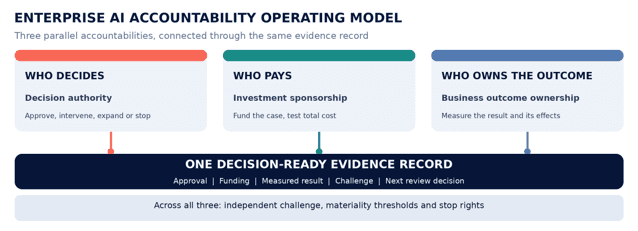
Figure 1. Enterprise AI Accountability Operating Model: three parallel accountabilities, one evidence record. Source: DigitalQatalyst, 6xD analytical synthesis (2026).

Accountability is more demanding than assigning a name to an organizational chart. Bovens (2007) describes it as a relationship in which an actor is answerable to a forum that can question, judge and potentially impose consequences. In enterprise AI, the practical requirement is a record that allows executives and directors to ask who made a decision, on what evidence, and what action followed an adverse result.
NIST's voluntary AI Risk Management Framework supports documented roles, continuing governance and decisions about whether deployment should proceed (NIST, 2023). The updated OECD AI Principles address accountability, traceability, correction and safe decommissioning (OECD, 2024). ISO/IEC 42001 specifies AI management-system requirements (International Organization for Standardization, 2023). These sources guide controls and responsibilities; they do not select an individual enterprise's investment sponsor or business outcome owner.
Within 6xD, Direction, Authority, Assurance, Performance and Accountability operate as one governance system. RP01 makes their connection practical for material AI investments. The initiative-level record is an application of the parent model, not another set of board domains.
Every material AI use requires a defined approval route. The route should identify who can propose a use, approve deployment, accept residual risk, expand permissions, authorize additional expenditure, intervene after an incident and retire a capability. Authority should follow impact and be documented before deployment.
Materiality test: Management should classify AI uses by financial exposure, consequences for customers or employees, legal and regulatory sensitivity, operational dependency, and the authority delegated to a model or agent. The enterprise should approve thresholds suited to its jurisdiction, risk appetite and scale. Crossing a reserved-matter or risk threshold triggers the designated governing body; routine approvals remain with authorized management. This is a proposed governance test, not a universal legal threshold.
The board or its designated committee governs enterprise ambition, material investment limits, risk appetite, reserved decisions and the quality of management oversight, subject to applicable law and the organization's constitution. The CEO and executive committee assign accountable owners, prioritize investments and resolve cross-functional decisions inside those limits. Business executives accept changes to their processes and remain answerable for service or financial outcomes. Technology, finance, risk, legal and assurance specialists contribute expertise and independent challenge without silently inheriting the business result.
Table 1. Illustrative AI decision rights and corresponding evidence. Source: DigitalQatalyst, 6xD analytical synthesis (2026).
| Material decision | Typical accountable decision level | Evidence expected |
|---|---|---|
| AI ambition, reserved capital commitment, material autonomy expansion | Board or designated approval body, as applicable | Mandate, reserved-matter record, thresholds |
| Portfolio funding and priority within approved limits | CEO, executive or investment committee | Business case, sponsor, portfolio decision |
| Workflow deployment and operating acceptance | Authorized business executive with technical and risk challenge | Acceptance, controls, business outcome owner |
| Material exception, incident, suspension or retirement | Authority assigned by severity and delegation | Exception record, escalation, decision trail |
These are illustrative allocations, not universal statements of directors' legal duties. A bank, public agency and private manufacturer may require different governance routes. The constant is an explicit, proportionate decision right.
Board test: For the five most material AI initiatives, can management identify the person authorized to expand the use and the person authorized to stop it? A committee name without a recorded decision right is insufficient.
The budget holder is not necessarily the business sponsor. A CIO may fund a common platform, finance may control disbursement, and a business unit may expect to receive the economic benefit. If those roles are blurred, the enterprise cannot tell whether it is financing a reusable capability, a local outcome or an experiment that should end.
The investment record should include full-life cost, not only the initial model or license charge. Depending on the use, material costs may include data preparation, integration, evaluation, inference, security, oversight, workforce training, operating changes, vendor dependence and retirement. The sponsor should own the economic proposition; the CFO and finance function should test assumptions, actual spend and the credibility of claimed benefits.
Funding can be central, business-led or shared. No model is intrinsically superior. What matters is a clear account of who authorizes the next tranche, who bears ongoing costs, which benefits are expected, when they will be measured, and who can correct or terminate the investment. An approval to pilot should not become an indefinite approval to operate at scale.
Before releasing more funding, management should show operating evidence, actual cost, emerging business outcomes and risk exposure. The sponsor recommends a funding decision; finance challenges costs and benefits; risk or legal specialists challenge relevant exposure. The authorized decision-maker records whether to release, restrict or stop the next tranche. Pilot approval does not automatically authorize scale.
Investment question: If the business case no longer holds, which executive can recommend stopping the initiative, and who is authorized to make that decision?
Business value occurs in the work, service or decision that changes, not in the model itself. An AI assistant can improve draft speed while end-to-end customer outcomes do not improve. A prediction can become more accurate while the organization does not act on it. For this reason, the business executive with authority to change the affected process should ordinarily own its intended result.
Outcome ownership needs a baseline, an observable target, a timeframe, a measurement method and a record of dependencies. The result may be revenue, cost-to-serve, cycle time, customer outcome, reliability, safety or control effectiveness. A financial return estimate is useful when credible, but not every public-service or risk-reduction outcome can be responsibly translated into a single monetary figure.
Measurements should distinguish deployment evidence (the tool was launched and used), operating evidence (the work changed) and enterprise outcome evidence (the intended business effect occurred). These are evidence levels within one accountability record, not competing frameworks. Report realized benefits separately from forecasts and reconcile claimed benefits where several functions report the same saved hours or cost reductions.
In 2024 McDonald's announced the end of its automated drive-through ordering trial with IBM and said it would keep examining voice-ordering solutions (Grantham-Philips, 2024). Public reporting establishes the discontinuation decision, but does not disclose the company's internal return on investment, accountability assignments or full decision rationale. The 6xD implication is specific: management should document the evidence and decision authority behind choices to expand, redesign or end consequential AI trials.
The board's platform-change test: If the technology platform changed tomorrow, would the same business executive still be accountable for the outcome? If the answer is unclear, ownership may be attached to the vendor or model rather than to the result the enterprise expects.
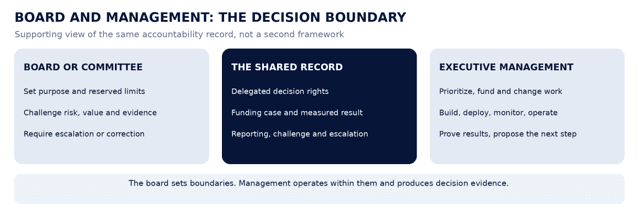
Directors should govern the purpose, limits and evidence of material AI activity; management should build and operate within those conditions. Directors selecting models become a substitute delivery team. Management treating AI as an isolated IT matter removes consequential investment and business outcomes from proper challenge.
Figure 2. Board-management decision boundary, a supporting view of Figure 1. Source: DigitalQatalyst, 6xD analytical synthesis (2026).

The full board, a specialized committee or distributed committees may each be suitable, depending on materiality and governance context. A distributed arrangement still needs integrated reporting, reserved decisions and an escalation route. Committee labels are less important than clear authority and evidence that unresolved issues reach the appropriate forum.
The CEO is accountable to the board for organizing executive responsibility. An investment sponsor owns the funding proposition; the business outcome owner owns process results. The CFO challenges costs and benefits. The CIO owns the technical service. Risk and compliance challenge exposures. Internal audit may provide independent assurance and should remain separate from operational ownership. The Company Secretary can preserve decisions and reporting continuity. These are common functional contributions, not a mandated universal chart.
McKinsey's 2025 survey reports an association between CEO engagement in AI governance and self-reported financial impact, not a causal relationship. Board oversight therefore needs clear delegation and challenge, rather than CEO sign-off on every deployment.
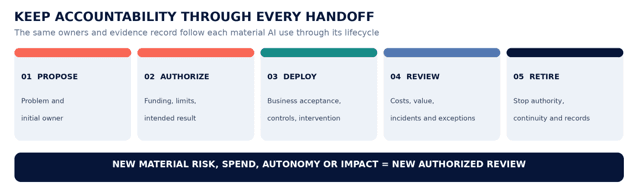
Ownership must survive handoffs. A sponsor can disappear after project authorization, an approved pilot can gain new production permissions without fresh challenge, and a system can remain active long after its value assumptions cease to hold. One initiative record should therefore follow the use across the lifecycle, with controls that determine when the same owners must make a new decision.
Figure 3. Five decision checkpoints that keep the Figure 1 record current. Source: DigitalQatalyst, 6xD analytical synthesis (2026).

At proposal, record the business problem, affected process, initial owner, alternatives and foreseeable risks. At authorization, approve funding, delegation limits, target outcomes and the evidence needed for expansion. At deployment, confirm technical and business acceptance, controls, intervention rights and operating responsibility. At review, compare actual cost, benefit, incidents and changed autonomy with the approved case. At retirement, document authority to disable, replace or revert the capability, including continuity and data obligations.
These checkpoints belong inside existing investment, transformation and AI-management processes. NIST (2023) supports continuing review and decommissioning. RP01 keeps the economic case, delegated authority and business outcome owner visible whenever a decision changes exposure.
Review frequency should match risk and rate of change. A low-risk internal assistant and an agent able to execute consequential transactions should not necessarily share a reporting schedule. A material model or permissions change may itself trigger an out-of-cycle reassessment.
At each checkpoint management should be able to answer the same question: What evidence authorizes the next decision, who is accountable for making it, and who owns the outcome?
Agentic AI can be configured to use tools, pursue objectives and carry out multi-step actions. A system that recommends a purchase is different from one allowed to issue it. A customer-support tool that drafts a response is different from one allowed to settle a claim. The governance variable is the authority delegated to the system, together with the possible consequences of its actions.
Management should specify what an agent may observe, recommend, decide, execute, transact or delegate to another agent. The record should include data access, financial limits, prohibited actions, approval points, logging, incident response and stop authority. Controls should be technically enforced when feasible. A written policy cannot alone prevent an integrated system from executing an action that its credentials permit.
Autonomy does not make an agent a corporate officer. Named people retain organizational accountability, while contractual and legal responsibilities depend on the circumstances and jurisdiction. The OECD AI Principles emphasize appropriate traceability, oversight and mechanisms for correction or safe shutdown (OECD, 2024). Evidence should permit management to reconstruct meaningful sequences of tool use and delegated actions, not merely the last output.
Stanford's 2026 AI Index reports that agent deployment remained in the single digits across nearly all surveyed business functions in 2025 (Stanford HAI, 2026). That survey indicator suggests an opportunity to establish delegated-authority limits early. It does not predict how quickly a particular enterprise's agent exposure will grow.
Board challenge: Which AI-enabled actions can move money, alter customer rights, change a regulated record or commit the enterprise without case-by-case human approval? The answer must identify the authority limit, accountable person, monitoring evidence and intervention route.
Figure 1 is the initiative-level evidence instrument within the published 6xD Enterprise AI Governance System, particularly its value and investment, authority and autonomy, and accountability domains (Niango, 2026a). Organizations can maintain the record within existing investment, transformation or risk registers.
The record connects three distinct accountabilities: decision authority to approve, expand, intervene or stop; investment sponsorship for the economic case and full-life cost; and business outcome ownership for measured results. Independent challenge and lifecycle review apply across all three. A single executive may hold more than one accountability where delegations permit, with appropriate checks.
The reviewer should be able to see the authorized decision, its financial basis, the intended result and the evidence at the latest review. Table 2 states the minimum fields.
Table 2. Minimum evidence for an Enterprise AI accountability record. Source: DigitalQatalyst, 6xD analytical synthesis (2026).
| Record field | Minimum evidence for the decision |
|---|---|
| Scope and materiality | Stable initiative ID; affected business process; classification rationale; applicable approval threshold. |
| Decision authority | Named approver for deployment, expansion, intervention and stop; delegated limits; dated approvals. |
| Investment sponsorship | Named sponsor; approved funds and full-life cost; next funding gate; finance challenge and reconciliation. |
| Business outcome | Named executive; baseline, measurable target, review period and method; quality, harm or control indicators. |
| AI permissions and assurance | Approved model or agent actions; access and transaction limits; exceptions; test results; independent challenge. |
| Decision history | Dated evidence; expand, correct, pause or stop decision; conditions, corrective owner and next review date. |
Illustrative record, not client results: Consider an AI-assisted claims triage service, CLM-AI-01. The COO approves deployment within agreed limits. A claims transformation sponsor proposes a hypothetical \$500,000 funding ceiling, while finance independently tests the full-life cost. The head of claims operations owns the handling-time result. An illustrative baseline of 12 calendar days and target of nine days are assessed alongside complaints, error rates and net cost.
The CIO owns technical reliability; risk challenges the control limits; internal audit remains independent. At the 60-day review, the outcome owner submits operating evidence and finance reconciles actual spending. The COO records the decision to expand, correct, pause or stop. Expansion is withheld when approved customer-harm or error thresholds are exceeded.
These figures are illustrative, not client results. If handling time falls while rework or complaints rise, the outcome owner should explain the trade-off before the authorized approver decides whether to correct, limit or stop the use.
D2 explains cross-functional authority; D4 connects delivery to measured results; D3 concerns shared platform foundations; and D5 concerns human-machine work (Niango, 2026b). The accountability record complements existing financial, risk, privacy and regulatory duties.
A board can commission a 90-day review of a small set of material uses. This is an improvement cadence, not a legal deadline. Management prepares evidence and executes changes; the board or delegated governing body reviews reserved decisions.
Days 1–30: Establish the baseline. Ask the CEO to select five to ten material AI uses, including one live operational deployment and any consequential agent actions. Collect approval authority, funding sponsor, outcome owner, full-life cost, baseline, target, risk limits and the last recorded decision. Mark missing evidence as missing rather than guessing.
Days 31–60: Repair the gaps. Management proposes corrected delegations, funding gates and stop rules; the governing body approves any reserved changes. Finance reconciles full-life costs and claimed benefits. Business executives confirm outcome baselines and ownership. Risk and legal functions test material exceptions. Each unresolved issue receives an accountable corrective owner, deadline and escalation route.
Days 61–90: Prove that the system operates. Run a portfolio review. Challenge one proposed expansion and one underperforming or high-exposure initiative. Record the authorized decision and next review date. The board should ask for evidence of changed decisions, not merely completed governance templates.
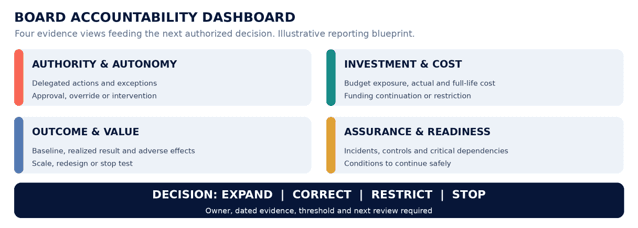
Figure 4. Board accountability dashboard, a reporting view of the Figure 1 record. Source: DigitalQatalyst, 6xD analytical synthesis (2026).

The dashboard should lead to decisions, not another status pack. Show material authority and exceptions, funded exposure and total cost, baseline and measured outcome, plus incidents, unresolved controls and dependencies. Each indicator needs an owner, evidence date, threshold and next review action. Figure 4 is a reporting blueprint, not client performance data.
-
Apply the five reflection questions to the same material initiative. Link each answer to a dated approval, operating test or outcome measure. Record partial and missing evidence with an owner and deadline. Expansion follows the enterprise's risk thresholds and reserved-matter rules.
Table 3. Accountability evidence status and next action. Source: DigitalQatalyst, 6xD analytical synthesis (2026).
| Status | Evidence threshold | Required response |
|---|---|---|
| Evidenced | Current accountable owner, valid approval or control, and dated operating or decision evidence. | Record the next review and continue monitoring against agreed conditions. |
| Partial | Responsibility is assigned, but a current test, measure, decision record or control demonstration is absent. | Assign a corrective owner and deadline. Require review before any material expansion that depends on the missing evidence. |
| Missing | No current accountable owner, valid authority or supporting evidence for a material use. | Escalate to the authorized decision body. Determine whether to restrict, pause or withhold expansion until the gap is resolved. |
This is a qualitative evidence screen, not a validated maturity score. It does not replace the 6xD Navigator Enterprise AI Governance Gap diagnostic. Decisions to pause or stop must follow the enterprise's delegated authority, applicable duties and risk thresholds.
Research basis and limits: HFS Research (2026) surveyed 302 Global 2000 executives about accountability after negative AI-influenced decisions. This provides evidence of uncertainty in that sample, but does not measure the full decision-rights, investment-sponsorship and outcome-ownership gap. Stanford HAI (2026) draws on McKinsey survey data; McKinsey & Company (2025) separately reports workflow redesign. Neither measures the complete accountability gap. Brynjolfsson et al. (2025) report task-level effects in one workplace setting rather than net enterprise returns. NIST, OECD and ISO provide governance guidance. Public reporting on McDonald's trial decision does not disclose its internal investment case or approval process. The 6xD model is an analytical proposal, not a validated intervention or universal legal duty.
An AI deployment may meet its technical specification while the enterprise case remains unproven. The connected accountability record makes the next funding choice reviewable: who authorized the use, who sponsored the spend, who owns the result and what the latest evidence shows. Where results or controls fall short, management proposes correction, restriction or termination for an authorized decision.
The board need not govern every model. It does need to govern the enterprise consequences those models are helping to create. Before increasing AI exposure, ask management for one reliable answer to who decides, who pays and who owns the outcome.
Identify where authority, investment sponsorship and business outcome ownership are unclear before approving more AI exposure. Use 6xD Navigator's Enterprise AI Governance Gap (NAV-04) assessment to examine decision rights, investment accountability and outcome ownership, then review your governance exposure heatmap
Marketing, technology, finance, risk and operations can each own part of an AI initiative while nobody has authority to settle a consequential dispute. Shared delivery needs an explicit decision route.
An approved AI budget does not establish who owns the promised business result. Responsible investment requires a named decision authority, investment sponsor, business outcome owner and one evidence record.
Marketing, technology, finance, risk and operations can each own part of an AI initiative while nobody has authority to settle a consequential dispute. Shared delivery needs an explicit decision route.
An AI assistant can reach more users, connect to new workflows and gain permission to act without its approval record changing. Boards should test whether the authority on paper still matches actual AI use.