Executive Summary
Before AI gains more funding or authority, directors need seven explicit decisions to govern its enterprise consequences.
An AI assistant drafts supplier orders. Once connected to purchasing software, it may submit them. The enterprise has granted new business authority. Who approved it, what spending limit applies, and who can stop or correct an unauthorized order?
Context
In a 2026 EY survey of 202 senior AI decision-makers at publicly traded US companies with annual revenue of at least USD 1 billion, 98% reported formal AI governance policies, while 47% said their organizations had bypassed governance processes for urgent deployments [4]. Separately, ISS STOXX found that 245 of 3,048 US companies disclosed board-level AI oversight [5]. EY reports respondents' accounts; ISS STOXX measures public disclosure, not oversight effectiveness.
This 6xD interpretation applies RP01's five governing functions and eight responsibility domains to seven board decisions [1]. Readiness (R8) tests whether evidence supports material expansion of investment or authority. It does not create an eighth decision or new legal duties.
Thesis
Under the G20/OECD Principles, boards oversee strategy, major investments, performance and material risk [2]. AI becomes a board issue when it changes those outcomes or delegated authority. The board sets limits on material AI decisions; management operates within them. Formal approvals depend on applicable law, materiality and governance documents.
Structured Analysis
Seven decisions directors need to make explicit
1. Set the enterprise's AI ambition and exclusions
Agree which business outcomes justify material AI use and which uses remain outside strategic or risk limits. Management proposes opportunities and delivery plans. Directors challenge whether the portfolio serves enterprise priorities.
Board output: an agreed ambition, measurable outcomes and explicit review triggers.
2. Define the evidence required to fund or scale
Determine what evidence must support material funding or scale. Require a baseline, total cost, named benefit owner and observed results against forecasts. Adoption and pilot counts alone cannot establish value.
Board output: approve, condition, defer or stop investment based on evidence.
3. Reserve consequential decision rights and name owners
Specify which consequential AI-enabled actions require human approval or escalation. Management assigns executive owners and administers permissions. An assistant recommending a purchase differs from one placing it.
Board test: Who authorized the action, who owns the outcome and who corrects its effects?
4. Set risk appetite and the assurance threshold
Define acceptable exposure and escalation thresholds for privacy, cyber, fairness and service risks. Management tests safeguards and records unresolved findings. NIST's voluntary AI Risk Management Framework offers Govern, Map, Measure and Manage functions, but adopting it does not prove controls work \[3\].
Board output: risk limits and responses to assurance gaps.
5. Decide when changes to work and human authority need board review
Identify workforce or process changes significant enough for board review. AI may reduce effort in one task while shifting judgment or review burden elsewhere. Management redesigns work and prepares staff to handle exceptions.
Board output: oversight triggers supported by evidence of employee competence, beyond training attendance.
6. Decide which critical dependencies the enterprise can accept
Decide which concentration and interruption risks are acceptable for critical AI-enabled services. Management maps shared providers, data and system dependencies and tests continuity plans. Contractual exit rights do not guarantee recoverability.
Board test: Which essential service could fail, and has recovery been tested?
7. Set the conditions for greater AI-agent autonomy
Define when greater agent autonomy requires renewed approval. Management configures access, transaction caps, human checkpoints and intervention controls. New tool connections or higher spending limits can change the original delegation.
Board output: an escalation route supported by tested detection, stop and correction procedures.
These decisions operate as one system. An AI purchasing agent might reduce processing time while gaining spending authority, depending on a single provider, and changing who checks exceptions. A promising investment case alone cannot resolve those risks. Before material expansion, directors need a connected view of value, accountability, delegated rights, continuity, and safeguards. An untested critical control cannot be offset by a favorable average readiness score. Management should remedy the gap before proposing wider authority.
Leadership Implications
These seven decisions focus directors on material consequences rather than technical implementation. Each decision should show what AI may do, why it serves the enterprise, who owns the result and how intervention works.
Next Step
A decision test for the next board meeting
At the next board or technology committee meeting, select one material AI initiative seeking funding, wider use or greater autonomy. Ask management for six facts: intended outcome, accountable owner, delegated rights, value and risk evidence, approved limits and tested intervention route.
FIGURE 1 | SIX-FIELD RECORD FOR A MATERIAL AI DECISION
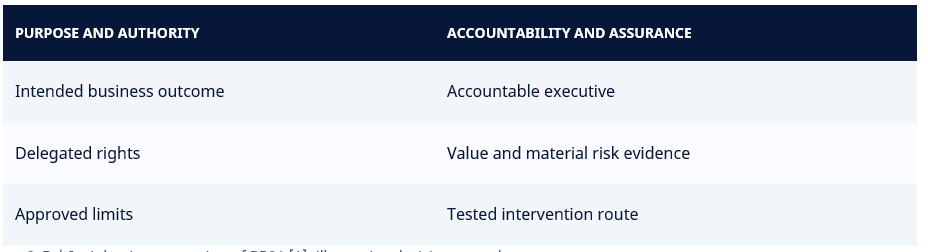
Ask: If this system could take one further action tomorrow, what consequence would it create, who could approve it, and what evidence supports that permission?
Record a disposition: approve, condition, amend, defer, restrict or stop. When a material owner, baseline, limit or intervention test is missing, defer expansion and assign corrective action. Management retains authority to contain incidents immediately.
Is your board ready for the next AI decision?
Take the six-minute Board AI Governance Scorecard in 6xD Navigator to assess oversight of AI investment, risk and value and receive a board oversight score. This is a self-assessment, not independent assurance.
Sources
- 01ISS STOXX (2026), Mind the Governance Gap. Board AI oversight disclosure analysis of 3,048 US companies.
- 02EY (2026), AI Risk and Governance Survey. Self-reported survey of 202 senior AI decision-makers at publicly traded US companies with at least USD 1 billion in revenue.
- 03 NIST (2023), AI Risk Management Framework (AI RMF 1.0). Voluntary guidance, not proof of control effectiveness.
- 04 OECD (2023), G20/OECD Principles of Corporate Governance 2023, section V. Governance principles, not universal legal duties.
- 056xD | Insights (2026),Why AI Governance Is Becoming a Board-Level Responsibility .