The Board Mandate, Decisions, and Accountability.
The board question has changed
An AI assistant authorized to alter a customer account can exercise business authority. AI investment can also grow without evidence of value beyond deployment. Who approved that authority, who owns the expected outcome, and who can intervene when results breach agreed limits? Pilot counts and implementation milestones cannot answer these questions.
These are board-level questions because AI can alter enterprise strategy, capital allocation, risk, organizational design, and delegated decisions. The board must set oversight boundaries, challenge management's evidence, and hold executives accountable for material outcomes. Management remains responsible for choosing, building, and operating AI systems.
ENTERPRISE AI GOVERNANCE | BOARD MANDATE & DECISION RIGHTS
Executive summary
AI now shapes enterprise decisions, workflows and, increasingly, actions. Pilot counts and deployment updates do not show whether AI has the right authority, delivers business value or operates within acceptable risk. The 6xD position is clear: The board governs AI's enterprise consequences; management governs execution.
Formal policies do not guarantee consistent practice. In an EY survey of 202 senior AI decision-makers at large publicly traded US companies, 98% reported formal governance policies, yet 47% said their organizations had bypassed governance processes for urgent deployments \[3\]. These self-reported results concern a specific group, not all enterprises. They reinforce the need for directors to examine decisions and controls in operation.
This paper applies the existing 6xD Enterprise AI Governance System, with five governing functions, eight responsibility domains and a clear board-management boundary. It translates that architecture into seven board responsibilities covering strategic ambition, investment value, accountability and decision rights, risk and assurance, workforce and organization, data and technology dependencies, and agentic AI autonomy. Readiness should govern any material expansion in investment, exposure or delegated authority.
Over the next 90 days, boards should confirm oversight and escalation rights, identify material AI uses and accountable owners, require evidence of outcomes and risks, and test one consequential workflow. The practical test: If the AI technology changed tomorrow, could directors still identify the accountable owner, intended business outcome and authority to intervene?
1. Why enterprise AI has become a board responsibility
Corporate boards already oversee strategy, major capital decisions, organizational performance, and material risk. The G20/OECD Principles describe those governance functions and distinguish board oversight from the management of day-to-day operations \[4\]. AI falls within that established mandate when it changes the enterprise's ability to compete, spend, decide, serve customers, manage obligations, or organize work. It does not require a new theory of legal duties in every jurisdiction.
The change is visible in three movements. First, AI spending can become significant before benefits are measured consistently. Second, AI output can influence consequential human decisions, even where the system does not formally approve them. Third, some systems can initiate actions through software tools and connected business processes, creating exposure beyond the original task. A procurement assistant that drafts a recommendation presents a different authority problem from an agent permitted to place orders.
Two independent indicators provide context, although they measure different populations and outcomes. Stanford's 2026 AI Index, drawing on a 2025 survey, reports that 88% of surveyed organizations used AI in at least one business function \[1\]. Separately, ISS STOXX found that 245 of 3,048 US companies (8%) disclosed board-level AI oversight in its January 2026 disclosure data \[2\]. Self-reported adoption is not evidence of realized value, and disclosure does not establish the absence or quality of oversight. The two rates should not be compared as a matched governance gap.
AI can produce real task-level benefits. A peer-reviewed study of 5,172 customer-support agents reported an average 15% increase in issues resolved per hour after access to an AI assistant, with considerable variation among workers \[9\]. That is evidence from a specific setting, not a universal forecast for enterprise returns. Directors should therefore demand a business baseline, an outcome owner, and an account of costs and conditions before accepting a claim of value.
Technical controls establish part of the assurance case. Directors also need evidence of business outcomes, tolerable dependencies, and clear authority for consequential decisions. That connects technology oversight to enterprise strategy.
The issue is materiality. A low-risk drafting tool may remain within routine management authority. A system used to determine eligibility, set prices, make commitments, or conduct transactions may deserve stronger controls and higher-level review. Boards need a rule that changes the oversight route as consequences, authority, or exposure change.
2. What remains management's responsibility
The board must set expectations without becoming an AI delivery committee. Its responsibilities are to establish the enterprise ambition, approve reserved decisions, oversee risk appetite and performance, appoint and challenge accountable executives, and obtain sufficient evidence to discharge its oversight duties. The precise allocation depends on governing documents and applicable law.
Management owns the AI portfolio and delivery: business cases, process redesign, vendors, architecture, testing, deployment, security, workforce enablement, monitoring, incidents, and retirement. It operates within approved budgets and authority limits and escalates material exceptions. Directors challenge the results and the basis for decisions without making technical choices on management's behalf.
A useful governance contract makes five matters explicit. It defines which decisions are reserved for the board; which decisions are delegated to a committee or executive; what evidence must accompany a request; what events trigger escalation; and who can pause, contain, or stop an unsafe or ineffective system. These provisions should connect to existing corporate and risk governance rather than sit in an isolated AI policy.
Responsibilities also need separation within management. Business leaders own business outcomes. Technology and AI teams develop and operate capabilities. Risk, legal, privacy, compliance, and security functions provide specialist challenge. Internal audit may offer independent assurance without taking ownership of operational controls. This approach is consistent with the role distinctions described by the Institute of Internal Auditors \[10\].
Clear delegation prevents both dispersed decisions without enterprise visibility and unnecessary board involvement in routine implementation. Management retains room to execute; directors can challenge or intervene when approved limits or material exposure change.
3. The board's seven primary enterprise AI responsibilities
3.1 AI ambition and strategic alignment
The board should set expectations for what AI contributes to enterprise strategy. Management should explain the business problem, expected customer or operational result, and why the proposed capability is preferable to other options. Directors should challenge whether material investments support enterprise priorities rather than disconnected business-unit initiatives.
Strategic alignment also requires limits. Certain uses may conflict with the organization's risk appetite, reputation, or obligations even when technically feasible. The board should require a view of critical assumptions, priority capabilities, and conditions that would justify revisiting the strategy. The output is a defined AI ambition with measurable outcomes and an explicit review trigger.
3.2 Investment and value realization
The board should challenge investment decisions with the same discipline applied to other material capital and operating commitments. A credible AI business case identifies the baseline, total cost of ownership, benefit owner, realization period, and measures that distinguish activity from economic or service value.
Pilots completed, users activated, and prompts issued describe activity. They do not, by themselves, establish reduced cost, improved quality, faster service, lower risk, or additional revenue. Management should distinguish anticipated benefits from observed results and distinguish released employee capacity from cash savings. Funding decisions should include criteria for continued investment, wider deployment, correction, or termination.
3.3 Accountability and decision rights
AI can separate the person funding a capability from the person using it and the person affected by its outcome. That separation can make ownership unclear. For each material AI-supported process, management should name the executive accountable for the business outcome, the authority that approves use, the people who manage exceptions, and the owner of incidents and corrective actions.
A decision-rights record should distinguish what AI may recommend, what humans must approve, and which actions a system may execute under delegation. Accountability remains with organizational roles even when an automated component generates or initiates an action. The board should examine gaps in authority, especially across business units and shared platforms.
3.4 Risk, ethics, compliance, and assurance
AI risk is wider than model accuracy. Depending on the use case, material exposures can include privacy, discrimination, cyber compromise, unreliable outputs, intellectual-property disputes, operational disruption, regulatory obligations, and reputational harm. The board should establish its risk appetite and require management to apply proportionate safeguards to the use and its potential consequences.
NIST's AI Risk Management Framework proposes the voluntary functions Govern, Map, Measure, and Manage; its generative AI profile adds context for risks that may arise or intensify with generative systems \[5, 6\]. These are useful management references, but their existence does not prove that a control works. Directors need assurance findings, unresolved exceptions, incident trends, and evidence that corrective actions have been completed.
3.5 Workforce and organizational consequences
AI may change who performs work, who checks a recommendation, and who is authorized to decide. Management should explain how roles, processes, controls, incentives, and required skills will change. A productivity gain in one step can be offset by new review effort, downstream errors, or reduced service quality elsewhere.
The board should seek evidence that the operating model supports human-AI work. Relevant measures include competence on real tasks, quality after process redesign, workload effects, escalation behavior, and employee transition arrangements. Training attendance is useful context, but it is not proof that people can identify and correct AI failures. Workforce governance belongs with enterprise performance and accountability, not only with a technology rollout.
3.6 Data, technology, and third-party dependencies
Material AI capability often depends on external models, cloud services, internal data, connected applications, and vendors. These dependencies influence reliability, privacy, cost, resilience, and the organization's ability to change providers. A contract may offer termination rights while the underlying workflow remains difficult to replace or restore.
The board should require visibility into concentrated providers, sensitive data paths, the quality and permitted use of important data, security controls, service interruptions, and tested fallback arrangements. Directors do not need a systems diagram for every application. They need to know when a shared dependency could interrupt material services or compromise the enterprise's operating options.
3.7 Agentic AI and increasing machine autonomy
Agentic systems can use tools, retrieve information, plan steps, and initiate actions in connected environments. The board's central issue is the authority the organization gives those systems. An assistant proposing a refund and an agent authorized to issue one present different control and accountability requirements.
Management should document the limits of each consequential agent: permitted data and tools, transaction or spending caps, duration of authority, required human approval, monitoring, incident handling, and emergency intervention. Permissions that are acceptable in isolation may create a larger exposure when several agents act within the same process. Aggregate authority, shared credentials, and indirect effects need attention when material.
The repeatable board question: What enterprise consequence is this system allowed to create, who owns it, and who has the practical power to stop or correct it?
4. Board and committee decision rights
There is no single committee structure that suits every enterprise. Full-board oversight may work where AI is a strategic priority and directors have sufficient agenda capacity. A designated technology or AI committee may provide deeper technical scrutiny. Existing audit, risk, technology, and people committees may also divide the work, provided a common mandate and escalation route prevent fragmentation.
The full board should retain responsibility for enterprise strategy, material risk appetite, and the decisions its governing framework reserves to it. A committee can examine issues in depth and recommend action without becoming a substitute for full-board accountability. The chief governance officer or company secretary can maintain mandates, agendas, records, and follow-up, while operational ownership remains with management.
How each board role should use the mandate
The Board Chair should give strategic value, reserved decisions, and unresolved exposure sufficient agenda time. Non-executive directors should challenge management's benefit claims and assurance evidence. The Audit and Risk Committee Chair should examine risk appetite, exceptions, incidents, and control findings. The Technology or Digital Committee Chair should challenge material dependencies and changes in machine authority without taking over engineering. The Chief Governance Officer or Company Secretary should maintain the record of delegations, committee interfaces, escalation, and closure. These are functional contributions, not a universal allocation of legal duties.
Table 1. Board and management decision rights for enterprise AI
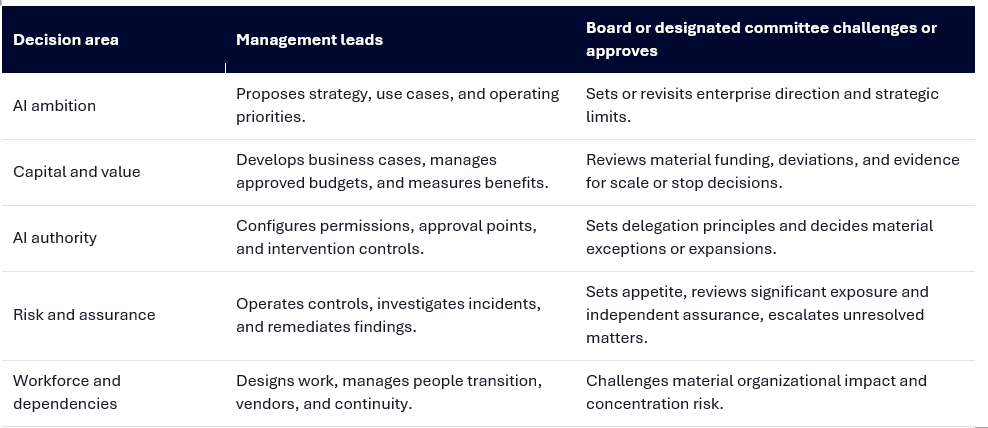
Escalation criteria should be written before a crisis. A change may require board visibility or formal approval when it exceeds financial limits, changes the kind of decisions AI can make, affects protected or vulnerable populations, increases critical dependency, crosses risk appetite, or prevents effective human intervention. Reporting to directors and obtaining their approval are different decisions. An incident containment action should not wait for the next scheduled board meeting when management already has authority to act.
5. The information boards should require from management
The board needs an integrated decision report, supported by records directors can inspect when necessary. A short dashboard should begin with requested decisions, material changes since the previous meeting, and unresolved exceptions. It should then connect the seven responsibilities to evidence, rather than presenting seven unrelated presentations.
Table 2. Minimum management evidence for board oversight
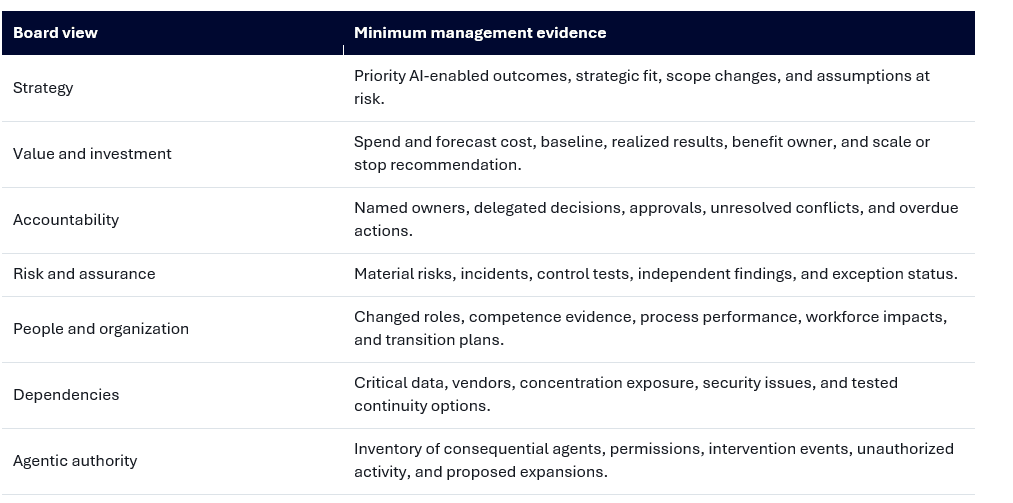
Good reporting is comparative and decision-ready. Every metric should have a defined period, owner, baseline, and interpretation. A low number of AI incidents could mean systems are performing well, or that detection and reporting are weak. High adoption can reflect successful integration, or uncontrolled proliferation. Directors should challenge what the number means before using it to approve more investment or authority.
The board should also require a clear exception route. Management must state which risks it cannot yet quantify, which dependencies are untested, and where evidence is missing. Uncertainty should be visible rather than hidden inside a reassuring overall maturity score.
6. Questions directors should ask
The questions below are designed for the next board or committee meeting. They correspond to the same seven responsibilities, so directors can request evidence without introducing another governance framework.
1.Strategy: Which enterprise outcome would justify our AI ambition even if the underlying technology changed?
2.Value: Which benefits have been measured against a baseline, and which remain forecasts?
3.Accountability: For our three most consequential AI uses, who owns the outcome and the exception?
4.Authority: Which decisions may AI recommend, which may it execute, and who granted permission?
5.Risk: What material AI exposure sits outside appetite, and who has accepted or escalated it?
6.Workforce: Where have human roles or approval points changed, and how has competence been demonstrated?
7.Dependencies: Which single supplier, dataset, or connected service could interrupt several important AI workflows?
8.Autonomy: Can we detect an unauthorized agent or an action outside approved limits?
9.Assurance: When did management last test intervention, rollback, and incident response in a realistic scenario?
10.Board effectiveness: What decision would we make differently after reading the current AI dashboard?
These questions should lead to recorded actions: approve, amend, investigate, defer, restrict, or stop. Their purpose is to improve judgment, not to generate more reporting.
7. Governance across the enterprise AI lifecycle
Governance begins before procurement or development and continues after deployment. A lifecycle approach reduces the risk that a capability is approved for one purpose and then quietly expanded to a different use, population, data source, or authority level. NIST and OECD guidance both emphasize continuing risk assessment across the AI lifecycle \[5, 7\].
Table 3. Enterprise AI lifecycle evidence and board relevance
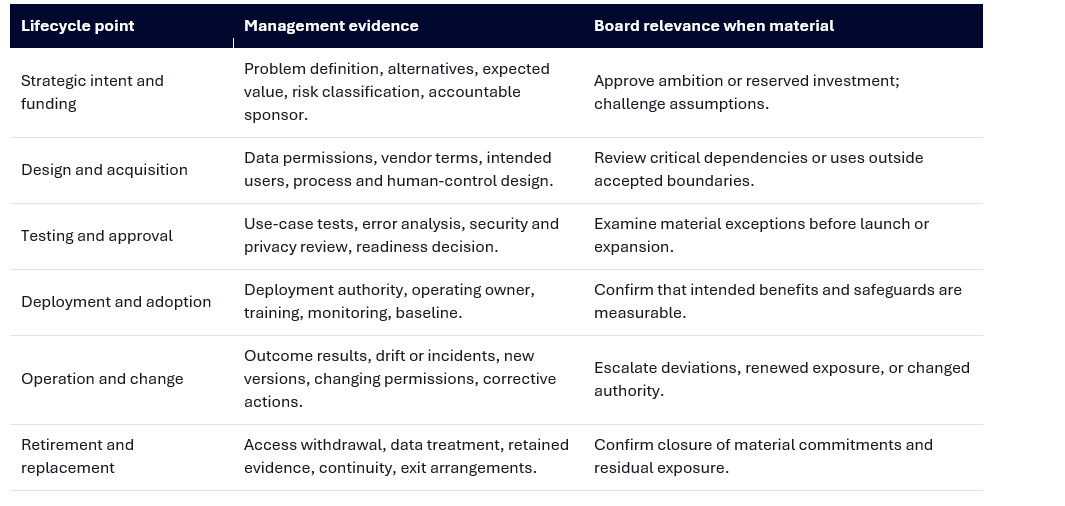
A material change should prompt reassessment even if the system name stays the same. Examples include connecting an assistant to a payment application, extending use into employment decisions, replacing a model provider, raising an agent's transaction limit, or removing a human approval step. Each can alter the consequences the original approval contemplated.
Three company-reported practices illustrate different control boundaries. Morgan Stanley describes AI Debrief as preparing a client-follow-up email that an adviser can edit and send at their discretion, preserving a human authorization point \[11\]. DBS describes a risk-based model register, named responsibilities, senior-management accountability, and greater review for generative AI uses \[12\]. Beyond financial services, Microsoft's 2025 Responsible AI Transparency Report describes pre-deployment review of higher-risk AI uses and an internal workflow to document responsible-AI requirements \[14\]. These are company-reported mechanisms, not independent demonstrations of control effectiveness or universal templates.
The board's task is to test whether management's review gates detect such changes and apply the right decision route. Routine testing and releases remain with executives within delegation. Material deviations return to the board or committee according to the governance contract.
8. Oversight of agentic and increasingly autonomous systems
Agentic AI makes the speed of action a governance consideration. A system that produces a recommendation may be checked before it affects the business. A system that can take several connected actions may create commitments before a reviewer sees the combined effect. Greater technical capability is not, by itself, permission to exercise greater business authority.
Consider a customer-service agent with authority to read an account, propose a remedy, and issue a refund below an approved threshold. The board does not need to approve individual refunds. It should expect management to define who owns refund policy, which customers and products are in scope, how spending limits aggregate, which exceptions require human approval, and what happens when the agent behaves outside those limits. If the same agent is later connected to pricing and credit systems, that expansion may require a different approval route.
The minimum authority record should answer six questions: What can the agent observe? What may it recommend? What may it change or execute? Which credentials, tools, and funds can it access? Who can interrupt its next action? Who can correct effects after an action has occurred? Stopping future activity and reversing an executed transaction are different operational capabilities, and both may matter.
Management should test for unauthorized tool use, unsuitable instructions, prompt injection, permission escalation, unexpected cross-system actions, and failure to recognize exceptions. These are plausible risk categories, not claims that every agent has the same failure modes. Control design should reflect the use case, technical architecture, and consequences. In EY's 2026 survey, 26% of respondents whose organizations used agentic AI reported that they could not detect unauthorized AI agents. The figure is self-reported within that survey population, but it makes detection a concrete question for oversight \[3\]. The OECD AI Principles call for appropriate human oversight, traceability, and the ability to repair or decommission systems when needed \[7\].
Boards also need a consolidated view of autonomy. A collection of individually low-value agents can create a material shared exposure through common providers, data, permissions, or aggregate spending. A board that sees only agent counts cannot determine whether authority is controlled. It needs the inventory of consequential agents, the changes in what they are permitted to do, the tests of intervention, and the status of significant exceptions.
9. Board AI Governance Operating Model: applying the 6xD system
The 6xD Enterprise AI Governance System is presented here as one proprietary board-level architecture: five governing functions (Direction, Authority, Assurance, Performance, and Accountability), eight responsibility domains (R1-R8), and the boundary between board oversight and management execution. The five-by-eight structure is a 6xD analytical proposition specified in this paper, not an externally validated standard or a separate model established by the 6xD foundation book. The seven responsibilities translate that system into practical board questions. Figure 1 shows the connection.
The mapping is not one-to-one. Accountability and decision rights draw on both Authority (R3) and Accountability (R4). Agentic autonomy is made visible to directors within the existing authority domain (R3). Maturity and readiness (R8) applies across all seven responsibilities as a gate before material investment, permissions, or autonomy expand. These are applications of the parent system, not new governance layers.
For each material use, management should maintain one traceable record: intended outcome, accountable owner, delegated limits, supporting control and value evidence, escalation threshold, and corrective-action route. The board requests that record when it must approve, challenge, restrict, or defer a decision.
Figure 1. One 6xD governance system, applied to seven board responsibilities
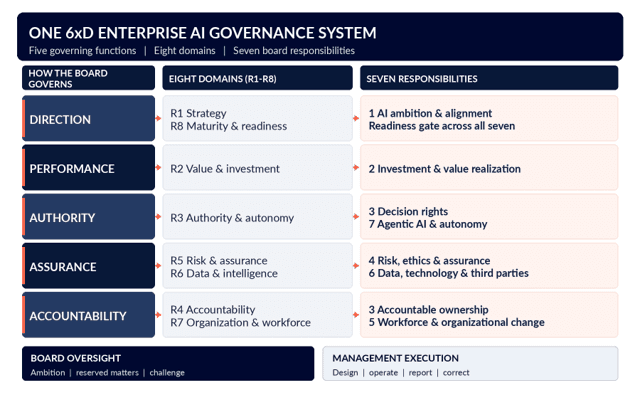
Table 4. Decision tests for the five governing functions
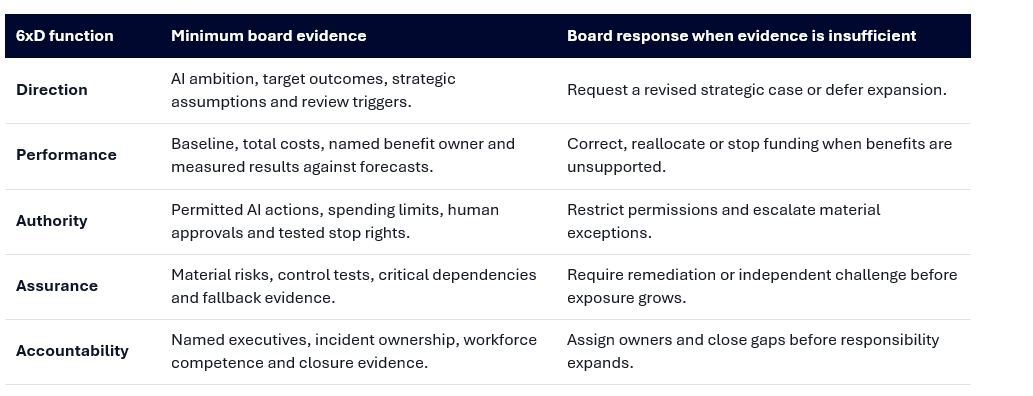
Management records each material AI use with its outcome, owner, authority limits, evidence and escalation route. Executives operate controls and close exceptions. The board challenges material deviations and tests corrective action as exposure or delegated authority grows.
The underlying 6xD interpretation is architectural. D2, the Digital Cognitive Organization, is the primary lens; D3 addresses platform foundations, D4 disciplined transformation, and D5 accountable human-machine work \[13\]. Enterprise AI depends on those dimensions acting together. The board governs the effects of those relationships on enterprise value and accountability. It should not mistake the model for a substitute for local legal advice, risk assessment, or technical assurance.
10. Board action agenda and maturity assessment
A governance model only becomes useful when it changes the board calendar and management's evidence obligations. The following sequence can be completed within a practical 90-day oversight cycle, subject to the organization having the necessary sponsors and records.
Days 1-30: Establish the mandate. The board chair and company secretary should confirm where AI appears in the board calendar and committee charters. The CEO should appoint an accountable executive owner and commission a register of material AI uses, investments, agents, and dependencies. Directors should agree which decisions are reserved, which are delegated, and which changes or incidents require immediate escalation.
Days 31-60: Test the evidence. Management should submit the first integrated dashboard aligned with the seven responsibilities. Finance should distinguish measured benefits from forecasts. Risk and assurance teams should identify material unresolved findings. Technology and business owners should reconcile the inventory of agents, permissions, and critical third parties. The board should require owners and due dates for missing evidence.
Days 61-90: Exercise the operating model. Select one consequential AI-enabled workflow and ask management to trace its business case, approval, owner, data and vendor dependencies, testing, monitoring, and authority limits. Then run a scenario in which the system produces a harmful recommendation, takes an unauthorized action, or becomes unavailable. Record who detects, contains, reports, restores, and closes the event. Use the results to revise delegations and reporting.
A practical maturity review should examine each of the seven responsibilities using the same four evidence states. Absent means no named owner or dependable record exists. Emerging means responsibilities and controls are described but have little operating evidence. Operating means the organization can show regular decisions, controls, and exception handling. Demonstrated means the evidence has been challenged, failures have been addressed, and results support the current level of authority. These are qualitative evidence statuses for this paper's review exercise, not the eight operating states of the parent 6xD maturity progression, an externally validated benchmark, or a legal compliance rating.
Do not turn the seven reviews into one reassuring average. A missing value owner, untested critical dependency, or weak agent permissions can defeat an otherwise strong profile. Before material expansion, require evidence of the intended outcome, accountable owner, permitted actions, tested safeguards, and a working intervention route. Where a material condition is missing, keep the current limit in place and agree corrective action and closure evidence.
For ongoing governance, the full board should revisit AI ambition, major exposures, and performance on a schedule appropriate to materiality. Relevant committees can review portfolio changes, assurance, workforce implications, and dependencies more frequently. Material incidents and changes of authority should trigger reporting between meetings. Annual reviews should reconsider director competence, charters, risk appetite, and critical assumptions.
Research basis, limitations, and interpretation
This paper is a selective, claim-led synthesis of institutional guidance, publicly reported corporate-governance data, an executive survey, a peer-reviewed workplace study, company-reported implementation examples from financial services and technology, and 6xD interpretation. It is not a systematic literature review, a regulatory opinion, or an empirical validation of the proposed 6xD operating model. Different sources answer different questions. Survey responses are self-reported, corporate disclosures do not reveal every governance practice, and productivity studies apply within their tested settings.
The 6xD recommendations are normative design propositions: they explain what an effective oversight contract could require. Their effectiveness should be evaluated locally through decision traceability, incident exercises, benefit measurement, exception closure, and independent challenge. Board mandates vary by jurisdiction, industry, ownership structure, and constitutional documents. Requirements under relevant laws and sector rules should be reviewed by qualified advisers in the organization's own context.
The paper also distinguishes governance of generative models from governance of enterprise outcomes. NIST AI RMF and ISO/IEC 42001 provide recognized risk-management and management-system references \[5, 8\]. The board application of the 6xD Enterprise AI Governance System addresses strategic value, authority, risk, organizational change, dependencies, and autonomy. Both levels are necessary, but their responsibilities should remain clear. The five governing functions and eight responsibility domains are identified as 6xD proprietary analysis within this publication. Niango's foundational 6xD volume \[13\] provides the broader D1-D6 perspectives, not independent empirical verification of this particular board-governance arrangement.
Conclusion: Govern the enterprise consequences
Enterprise AI becomes a board-level responsibility when its effects cross the boundaries of technology management into strategy, investment, accountability, risk, workforce design, business dependencies, and autonomy. Directors should govern material decisions and consequences through clear delegation, outcome evidence, and assurance. They do not need to manage individual models; executives retain responsibility for design, operation, and corrective action.
One connected governance mandate is more useful than a growing collection of unrelated AI committees, dashboards, and policies. The board should establish clear boundaries, require decision-ready evidence, and make intervention possible when outcomes or operating conditions change. The question that matters is durable across technologies: Can we explain what AI is authorized to do, why that authority serves our strategy, and who is accountable for the result?
Assess whether your board has the decision rights, evidence and intervention authority needed to govern material AI use.
Sources
- 01Stanford Institute for Human-Centered AI. (2026). AI Index Report 2026, Economy chapter.
- 02 ISS STOXX. (2026, March 3). Mind the governance gap: The state of board oversight and AI policy in U.S. companies.
- 03EY. (2026, September 15). EY survey finds that autonomous AI implementation outpaces oversight, yielding an AI governance gap.
- 04OECD. (2023). G20/OECD Principles of Corporate Governance 2023.
- 05Tabassi, E. (2023). Artificial Intelligence Risk Management Framework (AI RMF 1.0). NIST AI 100-1.
- 06 Autio, C., et al. (2024). AI Risk Management Framework: Generative AI Profile. NIST AI 600-1.
- 07 OECD. (2024). Recommendation of the Council on Artificial Intelligence, revised 2024.
- 08ISO/IEC. (2023). ISO/IEC 42001:2023, Artificial intelligence management system.
- 09 Brynjolfsson, E., Li, D., & Raymond, L. (2025). Generative AI at work. Quarterly Journal of Economics, 140(2), 889-942.
- 10Institute of Internal Auditors. (2026, July 8). Three Lines Model: Assurance and advice in support of effective governance.
- 11 Morgan Stanley. (2024, June 26). Morgan Stanley Wealth Management announces latest addition to suite of GenAI tools.
- 12 DBS Bank. (2025, October 6). Responsible and ethical AI in banking and finance.
- 13Niango, S. (2026). The Six Digital Perspectives (6xD): Volume 00. DigitalQatalyst. ISBN 9789948647935.
- 14Microsoft. (2025, June 20). Our 2025 Responsible AI Transparency Report: How we build, support our customers, and grow.