Executive Summary
A hypothetical customer complaint is classified accurately by an AI model, yet receives a late response because a new routing rule deprioritizes its category. The model meets its test criteria; the service promise may not. Who authorized the routing rule, and who can reverse it?
Context
The business rule is the real decision
An urgency classifier produces information. A service employee may treat its score as advice, while an automated system may use the same score to set queue priority. The output has not changed. The decision made with it has, along with its effect on customers.
Technical review remains essential. Teams must assess data suitability, performance, error patterns and security in the intended setting. The voluntary NIST AI Risk Management Framework addresses the business context of use (MAP 1.4), how outputs are used and overseen by people (MAP 2.2), and documented human-oversight processes (MAP 3.5) [1]. None of those checks chooses the organization's service commitments for it.
Before selecting a tool or finalizing the process, management should define the intended service outcome, non-negotiable conditions, decision owner and route to correction. Model performance then informs whether the proposed technology can support that decision. An accuracy metric cannot authorize the business rule on management's behalf.
Thesis
Those questions must be answered before the enterprise commits to the workflow, not only after the technology has passed testing. The core governance decision is what the business allows AI output to change, and who owns the consequences.
Structured Analysis
One prediction, two operating choices
In an assisted workflow, an employee sees a suggested urgency category and chooses the handling order. Management should test whether employees can challenge a suggestion, record an override and recognize a case that needs prompt review. A human presence alone does not guarantee that these safeguards work.
In an automated workflow, the score sets queue priority before a person reviews each case. Management must approve the routing policy, examine delays and exceptions, give affected customers a way to request review, and enable authorized staff to restore human handling. Both uses require oversight, but the controls differ.
Figure 1. One model, two operating choices. The same score informs a person or directs automated routing; both cases are hypothetical.
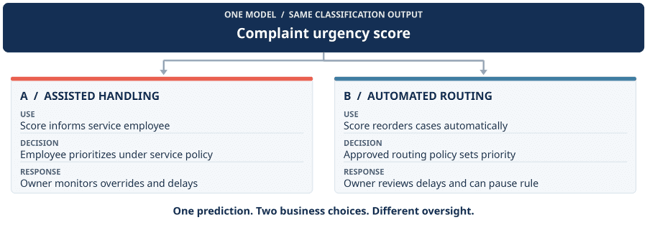
Neither workflow is inherently acceptable or unacceptable. Human review can be ineffective, while automated routing can operate within sound limits. Governance follows the decision made with AI, the people affected and the available remedies.
A technical pass does not settle the customer promise
Model tests can reveal errors across complaint types; they cannot decide how long a customer may reasonably wait or which exceptions deserve expedited treatment. A technically defensible score could still be used in a routing policy that weakens a service commitment or shifts rework to another team.
The business owner should state which improvement justifies the rule, what service standard must be protected, and how a customer can obtain review of a disputed priority. Management must determine when to revise or suspend routing. Legal and risk specialists should assess applicable obligations, but responsibility for the operating outcome stays with the business.
The relevant approval question is therefore whether the AI-enabled business decision is ready: its intended outcome, boundaries, accountability and remedy must be clear before rollout.
Show what happens after deployment
The approval record should identify the affected service rule, responsible executive, groups of customers affected, operating limits and the authority to intervene. It can sit within existing workflow approvals; the aim is to make the decision traceable, not create another committee or a separate bureaucracy.
After deployment, management should compare handling times with a pre-deployment baseline, review overdue cases and overrides, and investigate changes for particular complaint types. A rise in delays does not prove AI caused it; volume, staffing or policy changes might also matter. The owner should record the investigation, decisions and corrective action rather than attribute every adverse signal to the model.
An adverse pattern requires a response path. For example, if overdue priority cases rise, an authorized service leader should be able to investigate and, where justified, restore manual routing while the rule is reviewed. The example illustrates an operating safeguard, not a prescribed industry-wide threshold.
Leadership Implications
What should reach the board?
Directors do not need to review each classifier or queue threshold. Management owns process design, delivery and control operation. Where AI changes a material customer commitment, creates a significant risk or exceeds reserved decision limits, management should escalate the business consequence and response, not another technical status report. Escalation thresholds depend on applicable obligations and company governance arrangements.
The G20/OECD Principles of Corporate Governance identify board responsibilities for strategic guidance, monitoring performance and overseeing risk management and clear lines of accountability [2]. They do not prescribe a universal AI approval process. Applied here, the implication is that the board should challenge the enterprise consequences of consequential AI uses while management remains responsible for delivery.
The 6xD perspective: govern the use of intelligence
The D2 Digital Cognitive Organization perspective concerns an enterprise built to sense, learn and adapt. D3 Digital Business Platforms supplies the connected operating foundation; D4 Digital Transformation 2.0 concerns disciplined change; and D5 Digital Worker & Workspace concerns human-machine work design [3]. Their combined implication is practical: AI produces enterprise consequences through workflows, people and decisions, rather than in isolation.
This is a 6xD interpretation of how intelligence enters organizational work, not an independently validated AI governance standard. RP01 develops the wider board mandate and its seven responsibilities [4]. The immediate concern here is the operating decision that makes an AI output consequential.
Next Step
At the next board discussion, select one material AI-enabled process and ask the CEO: Even if the model meets its technical criteria, which business rule could still harm an important outcome, and who can change that rule?
The answer should name the rule, the accountable business executive, the evidence of its effects and a tested route to correction.
See the seven responsibilities behind your board's AI mandate →
Sources
- 01Tabassi, E. (2023). Artificial Intelligence Risk Management Framework (AI RMF 1.0). NIST AI 100-1, MAP 1.4, MAP 2.2 and MAP 3.5. [NIST publication (2023)
- 02OECD. (2023). G20/OECD Principles of Corporate Governance 2023, section V.D. [OECD publication] (2023)
- 03Niango, S. (2026). The Six Digital Perspectives (6xD): Volume 00.DigitalQatalyst, ISBN 9789948647935
- 04 6xD | Insights - DigitalQatalyst. (2026). Why AI Governance Is Becoming a Board-Level Responsibility: The Board Mandate, Decisions, and Accountability.